
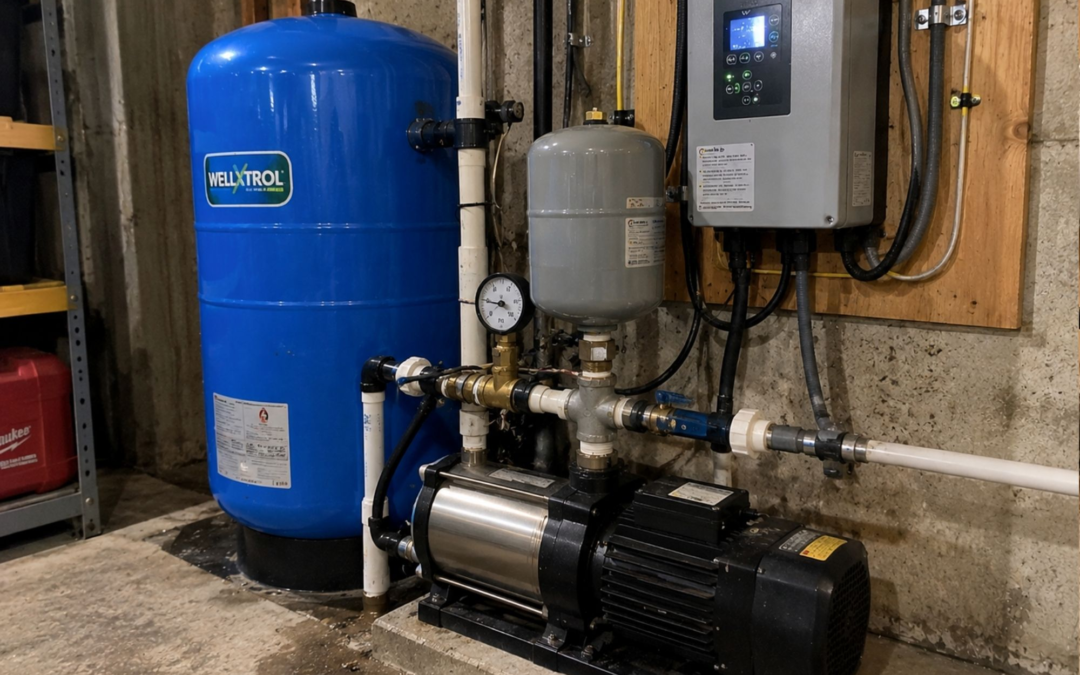
A shower that suddenly loses pressure when the washing machine starts can make a private well system frustrating to live with. A constant pressure well pump is designed to reduce those noticeable pressure swings by adjusting pump output as water demand changes. For homeowners in Mahopac, this type of system can be useful when several fixtures or appliances often need water at the same time.
Still, constant pressure is not automatically the right upgrade for every well. The better question is whether your existing pump, well yield, pressure tank, plumbing, and household demand support the change. Before replacing equipment, it helps to understand what the system actually does, where it can improve performance, and where it cannot solve the underlying problem.
What Is a Constant Pressure Well Pump?
A constant pressure well pump system adjusts pump operation to keep household water pressure closer to a selected setting as demand changes. Most modern systems do this with a pressure sensor and variable-speed control. When more water is needed, the controller can increase pump speed. When demand drops, the controller can slow the pump down.
This differs from a traditional well system that usually operates between a lower cut-in pressure and a higher cut-out pressure. With that setup, the pump turns on when pressure falls to a certain level and shuts off after the pressure tank reaches its upper setting. Homeowners may notice those changes as pressure rises and falls during normal water use.
Manufacturer information from Pentair describes a constant pressure controller that uses feedback from an electronic pressure transducer to adjust submersible pump motor speed as water demand changes. That helps explain an important point: the system regulates how the pump responds, but it cannot create more water than the well and pump can supply.
How Does a Constant Pressure System Work?
A constant pressure system depends on several parts working together. The pressure sensor monitors pressure in the water line and sends that information to the controller. The controller then adjusts motor speed to match changing demand. Instead of running only at full speed and then shutting off, the pump can increase or decrease output as household water use changes.
For example, turning on a single bathroom faucet may require relatively little flow. If a shower, washing machine, and outdoor faucet are used at the same time, demand rises. A properly selected variable-speed system responds by increasing pump output so the pressure stays closer to its set point. When those fixtures shut off, the controller reduces pump speed again.
This operating style is one reason some constant-pressure systems can use smaller pressure tanks than traditional systems. Franklin Electric’s SubDrive Utility documentation, for example, states that its variable-frequency-drive system requires only a small pressure tank in most applications. The tank still has an important job, but the variable-speed control handles more of the pressure regulation.
Is a Constant Pressure Well Pump Worth It?
A constant pressure system can be worth considering when pressure changes are a regular household problem, especially when several fixtures or appliances often use water at the same time. The biggest practical benefit is steadier pressure. It can make showers, faucets, and other fixtures feel more consistent during periods of heavier household water use.
That benefit tends to matter most when the existing system experiences noticeable pressure fluctuations but the well itself has enough available water to meet demand. A larger household, several bathrooms, outdoor water use, or appliances operating together can make changes in pressure easier to notice. In those situations, variable-speed control may provide a more comfortable and predictable water supply.
However, the added cost and complexity do not make sense in every case. If a conventional pump already provides comfortable pressure and adequate flow, replacing it simply to gain constant-pressure control may offer limited practical value. The decision should begin with the problem you are trying to fix rather than the assumption that newer pump technology must be better.
Constant Pressure vs. Traditional Well Pumps
Both traditional and constant-pressure systems can provide dependable household water when they are selected and installed correctly. The main difference is how they respond when water demand changes. A traditional pump typically turns fully on and off between preset pressure limits, while a constant-pressure system changes motor speed to keep pressure closer to a chosen setting.
| Feature | Traditional Well System | Constant Pressure System |
| Pressure behavior | Moves between preset pressure limits | Stays closer to a selected pressure |
| Pump control | Primarily on and off | Variable speed |
| Pressure tank | Usually larger | Often smaller |
| Controls | Simpler | More electronic components |
| Simultaneous water use | Pressure may vary more | Designed for steadier pressure |
| Installation complexity | Generally lower | Generally higher |
Neither design is automatically better for every home. Traditional systems are simpler and may make good sense when an existing system already meets household needs. Constant-pressure systems become more appealing when steady pressure during changing demand is a priority, and the well, pump, electrical supply, and plumbing can support the required performance.
Benefits of a Constant Pressure Well Pump
The most noticeable advantage is more consistent water pressure. With a traditional system, you may feel pressure decrease before the pump starts and then rise again as the system reaches its upper pressure setting. A constant-pressure controller responds more closely to changing water use, so those fluctuations can become less noticeable when the system is designed correctly.
Another benefit is how the system responds to simultaneous demand. If one person is showering while another runs a faucet or appliance, the variable-speed drive can tell the pump to increase output. This does not mean pressure can remain unchanged under every possible condition, but it can provide a steadier experience when the well and pump have enough capacity.
Many constant-pressure systems also use smaller pressure tanks, which may help where mechanical space is limited. Some variable-frequency drives use soft-start operation as well, allowing the motor to increase speed more gradually. These features should still be viewed as parts of an overall system rather than guarantees of energy savings, longer equipment life, or better performance in every home.
What Are the Disadvantages of Constant Pressure Systems?
The first drawback is added complexity. A traditional well system may use a pump, pressure tank, pressure switch, and relatively straightforward controls, while a constant-pressure system adds electronic sensing and variable-speed control. Those additional components have to be compatible with the pump, motor, electrical supply, and intended operating conditions.
Upfront cost is generally another consideration because constant-pressure equipment involves more advanced controls and setup. Electrical conditions also matter with variable-frequency drives. Manufacturer instructions may include requirements related to wiring, motor compatibility, pressure settings, protection features, and installation, so simply adding a controller to an existing pump is not always appropriate.
The largest limitation is one that homeowners can easily overlook: constant pressure cannot make an inadequate well produce more water. If water demand exceeds the sustainable supply from the well, increasing pump speed does not solve that shortage. Proper system selection has to consider both desired pressure and the amount of water that is actually available.
What Should You Check Before Installing One?
Correct sizing matters more than the label on the equipment. A constant pressure pump still depends on the amount of water the well can provide, how much water the household may use at one time, and how hard the pump must work to move that water through the system. Choosing equipment based only on horsepower or maximum pressure can lead to a poor match.
Before choosing a constant pressure system, the overall setup should be checked rather than looking at the pump alone. Important factors include:
- Available well yield
- Peak household water demand
- Pumping depth and vertical lift
- Pipe size and plumbing restrictions
- Pressure tank condition
- Pump and motor compatibility
- Electrical requirements for the controller
Changes in pressure may come from the tank, controls, clogged components, pump condition, well performance, or restrictions within the plumbing system. Looking at those conditions first helps avoid installing a more complex system when a repair or adjustment elsewhere would address the actual problem.
Can a Constant Pressure Pump Improve Low Water Pressure?
A constant pressure pump may improve pressure consistency, but it cannot solve every low-pressure problem. If the pressure change comes from a conventional pump repeatedly moving between its cut-in and cut-out settings, variable-speed control may make the water supply feel steadier. That situation is different from poor flow caused by a restriction or limited water availability.
Low pressure can also result from clogged filters, undersized piping, tank problems, pump wear, incorrect settings, or changing well conditions. If one of those issues is responsible, installing a constant-pressure controller without correcting the underlying condition may not provide the improvement the homeowner expects.
This is why a water system analysis can be useful before deciding on new equipment. A homeowner may describe the problem simply as “low water pressure,” but pressure, flow, well yield, storage, and pump capacity describe different parts of the system. Finding the cause first makes it easier to choose an appropriate solution.
Why Well Yield Matters With Constant Pressure
Well yield refers to how much water a well can provide over a period of time. A constant-pressure controller can change the speed of the pump, but the available groundwater ultimately limits how much water the system has to work with. That makes well performance an important part of pump selection, especially for properties with higher peak demand.
Imagine a home that suddenly needs water for two showers, laundry, and an outdoor fixture. The controller can tell the pump to increase output as demand increases, but that response still has limits. If the required flow is greater than what the well and pumping equipment can sustainably provide, constant-pressure control alone cannot close the gap.
This is also why installing the largest available pump is not necessarily the answer. Pump selection needs to fit the water source and the demands placed on it. Looking at well conditions, pump characteristics, pressure requirements, and household use together provides a much better basis for deciding whether a constant-pressure system makes sense.
How Long Do Constant Pressure Well Pumps Last?
There is no single lifespan that applies to every constant-pressure well pump system. Pump life can be affected by equipment selection, installation, water conditions, electrical conditions, workload, operating environment, sizing, and maintenance. The controller, pressure sensor, motor, tank, and pump are also separate components that may not all age at the same rate.
Broad claims that every constant-pressure pump will last a particular number of years should therefore be treated carefully. A properly sized pump serving moderate demand can operate under very different conditions from one that frequently works near its limits. Water characteristics can also affect equipment, while voltage problems or unsuitable installation conditions can affect electronic components.
If an existing system begins showing changes in pressure, unusual operation, control faults, or other performance problems, an inspection can help narrow down the cause. The problem could involve the pump, controller, sensor, pressure tank, plumbing, or water source. A symptom alone does not tell you which component needs repair or replacement.
Choosing the Right Well Pump System
Constant pressure technology can make a noticeable difference in homes where changing water demand causes uncomfortable pressure swings. Still, steady pressure depends on much more than installing a variable-speed controller. Well capacity, pump sizing, pressure settings, plumbing condition, electrical conditions, and household demand all need to work together. Understanding why the existing system is underperforming should come before deciding which equipment to install.
If you are considering a constant pressure system in Mahopac, Goldberg Plumbing & Heating can evaluate the well pump, pressure tank, controls, and overall water system to help determine which approach fits the property. A professional evaluation can also help distinguish a pump-control issue from limited well supply, plumbing restrictions, or another system problem before equipment is replaced. Contact us to schedule an evaluation or discuss your well water system.
FAQs
Is a constant pressure well pump worth it?
It can be worthwhile when your home regularly experiences noticeable pressure changes during simultaneous water use. The system changes pump speed as demand rises and falls, which can make showers, faucets, and appliances feel more consistent. If your current well system already provides comfortable pressure and enough flow, however, the additional cost and electronic controls may offer less practical benefit.
What is the best constant pressure well pump?
There is no single constant pressure well pump that is best for every property. The right equipment depends on well yield, required flow, total head, desired pressure, electrical supply, pump and motor compatibility, and how much water the household may need at one time. Matching those conditions to manufacturer specifications is more useful than choosing a pump based only on a brand name or horsepower rating.
What is a constant pressure well?
The well itself does not become “constant pressure.” The term normally refers to the pumping and control system, which uses pressure sensing and variable-speed operation to change pump output as household demand changes. Its purpose is to keep delivered pressure closer to a chosen setting than the wider pressure range homeowners may notice with a conventional on-and-off pump system.
Why is my pressure pump running continuously?
A variable-speed well pump may run for an extended period while water is being used because the system can reduce pump speed instead of immediately shutting the motor off. Continuous operation when little or no water is being used, however, can indicate a leak, control problem, pressure issue, plumbing condition, or another fault. The system should be inspected before assuming the pump itself has failed.
What are the disadvantages of a constant pressure well pump?
The main disadvantages are higher initial complexity and the addition of electronic controls. The system needs proper sizing and compatible components, and it still depends on the well having enough water to meet household demand. For homeowners whose traditional systems already provide good pressure and sufficient flow, the added equipment may not offer enough practical improvement to justify replacing a working setup.