When hot water suddenly stops, resetting the unit may seem like the quickest solution. However, learning how to reset a tankless water heater safely means doing more than pressing a button. You should record the error code, check the instructions for your model, and rule out signs of a gas, water, or electrical problem first.
This guide is for homeowners and small property owners in Northern Westchester and Putnam County who see an error code, have no hot water, or own a unit that keeps shutting down. Try only one manufacturer-approved reset. If the problem returns, schedule professional water systems service to diagnose the tankless water heater and correct the underlying fault.
Quick Answer: How to Reset a Tankless Water Heater
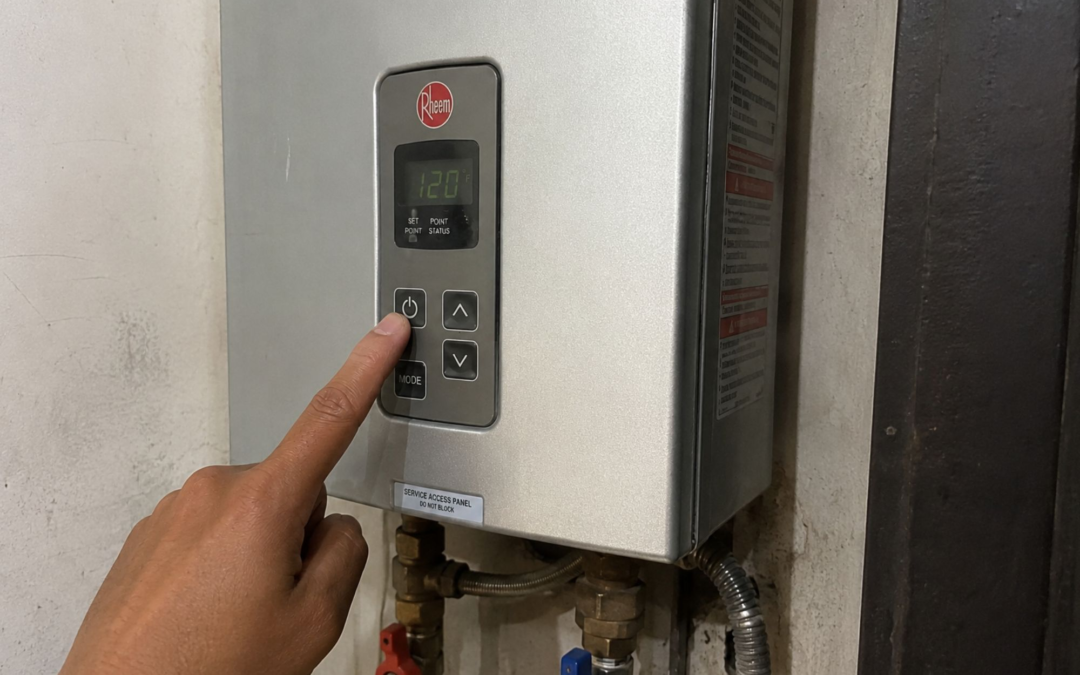
To reset a tankless water heater, save the error code, check the manual for your exact model, and turn the unit off using the approved control. Wait for the recommended period, restart the heater, and test one hot-water faucet. Stop if the same error returns.
- Photograph the error code.
- Confirm the brand and model.
- Follow the official reset instructions.
- Restart the unit and test one faucet.
- Call a plumber if the fault returns.
As a conservative homeowner safety rule, try no more than one manufacturer-approved reset unless the official instructions for your exact model and error code explicitly direct you to repeat the procedure. If the same code or shutdown returns, stop and arrange a professional diagnosis.
What Should You Check Before Resetting the Heater?
Before resetting the unit, record the displayed code, confirm the exact model, and look for conditions that make a homeowner-initiated reset unsafe. Error codes may point to low flow, failed ignition, overheating, combustion trouble, or an electrical fault. Clearing the screen too soon may remove information a plumber needs for diagnosis.
Record the Error Code
Take a clear photo of the control panel before turning off the heater. Write down what happened before the problem started, such as a power outage, cold weather, low pressure, recent plumbing work, or several fixtures running at once.
Useful information includes:
- The complete error code
- The heater’s brand and model
- Which fixtures were running
- Whether hot-water pressure changed
- Any clicking, rumbling, or fan noise
- Whether the unit has shown the code before
- Any recent flushing, repair, or electrical work
An error code does not always mean the heater has failed. It means the control system detected a condition outside normal operation. That condition may involve the heater, the water supply, the power source, the gas line, or the venting.
Find the Model Number and Manual
Look for a product label on the side, bottom, or front edge of the cabinet. The model number may also appear on installation paperwork or a warranty document.
Use that number to find the official manual on the manufacturer’s website. Do not follow instructions written for another model, even when both units come from the same brand. Reset buttons, waiting periods, control sequences, and error meanings can differ.
Where to Find the Correct Manual
Use the manufacturer’s official support or document library and search using the complete model number from the heater’s product label. Avoid relying on instructions for a similar-looking model because reset controls, error codes, waiting periods, and shutdown procedures may differ.
Common manufacturer resources include:
- Navien product manuals and support
- Rinnai document library
- Noritz support and technical documents
- Rheem product manuals
- Bosch product support
- A. O. Smith product literature
Use only the official manufacturer’s website or the manual supplied with the heater.
Look for Immediate Safety Concerns
Do not attempt a reset when the unit shows signs of a gas leak, water leak, damaged electrical component, or serious overheating. Leave the internal cabinet closed unless the manufacturer specifically describes a homeowner-safe action.
Stop and call for help if you notice:
- A gas odor
- Water leaking from the cabinet
- A burning or electrical smell
- Scorched wires or controls
- Water near an outlet or electrical connection
- A breaker that trips repeatedly
- Visible freeze damage
- Repeated failed-ignition sounds
If you smell gas, leave the property immediately. Do not use a phone, flip a switch, ring a doorbell, start a vehicle, or operate anything that could create a spark. After reaching a safe location, call 911 and your gas utility. Follow the emergency guidance provided by the utility serving your property.
How to Reset a Tankless Water Heater Step by Step
A safe reset normally involves saving the fault code, shutting the heater down through its approved control, waiting for the correct period, and restarting it. Homeowners should not remove internal covers, touch wiring, adjust a gas valve, change circuit-board settings, or bypass a safety control during the process.
Step 1: Turn Off the Heater
Use the shutdown method described in the manual. Depending on the model, this may involve:
- Pressing the front power button
- Using a wall-mounted controller
- Turning off a nearby service switch
- Unplugging the approved power cord
- Turning off the labeled circuit breaker
Keep your hands dry. Do not handle the power source if water has leaked near the heater or electrical connection.
Some online guides tell homeowners to remove the cabinet cover and insulation to locate a reset button. That advice does not apply safely to every tankless water heater. Many current units provide reset controls on the front panel or controller, and internal inspection should remain a professional task unless the official manual clearly states otherwise.
Step 2: Wait for the Manufacturer’s Stated Period
There is no universal waiting time for every tankless water heater. Some models restart immediately, while others require the power to remain off briefly so the control system can fully reset.
Check the manual for your exact model and follow the stated waiting period. Do not rely on a general one-minute or two-minute rule, since reset procedures vary between brands and models.
Step 3: Use the Correct Reset Control
The approved control may include:
- A button labeled “Reset”
- A return-arrow symbol
- The main on/off button
- A controller command
- A brand-specific button sequence
- A documented power cycle
Do not press and hold an unfamiliar button simply because a general online guide recommends three to five seconds. That timing may be correct for one model and wrong for another.
Step 4: Restore Power and Test One Faucet
Turn the heater back on and open one hot-water faucet far enough to create a steady flow. Watch the control panel while the system attempts to start.
Check whether:
- The burner or heating elements activate
- The water reaches the selected temperature
- The temperature remains steady
- The original error code returns
- The heater makes unusual noises
- The breaker trips
- Water begins leaking
Testing one fixture first makes troubleshooting easier. If one sink stays cold but other fixtures receive hot water, the problem may involve the faucet aerator, cartridge, mixing valve, or nearby piping rather than the heater.
Step 5: Stop if the Fault Returns
If the same code or shutdown returns, stop. Do not repeat the reset unless the official homeowner instructions for your exact model and error code specifically direct you to do so.
Save the returned code and arrange professional service. A reset may clear a temporary control fault, but it will not correct an active flow, pressure, scale, ignition, venting, gas supply, sensor, or electrical problem.
When Can Resetting a Tankless Water Heater Help?
A reset may restore operation after a brief power interruption, temporary control fault, or model-specific lockout. It will not repair low water pressure, mineral scale, blocked venting, an inadequate gas supply, damaged wiring, frozen components, or failed parts.
| Situation | Best Action |
| Power outage or temporary fault | Try one approved reset |
| Same error code returns | Arrange a professional diagnosis |
| Gas odor, leak, or breaker trip | Stop and call for help |
| Low pressure or scale buildup | Inspect the water system |
Follow the reset instructions for the exact brand, model, and displayed code. If the fault returns or dependable hot water is not restored, stop troubleshooting and arrange professional service.
Why Does a Tankless Water Heater Keep Needing a Reset?
A tankless water heater that repeatedly shuts down usually has an unresolved flow, pressure, scale, ignition, venting, sensor, gas-supply, freeze, or electrical problem. Restarting the unit may restore hot water temporarily, but the shutdown is likely to return until the underlying condition is corrected.
| Possible Cause | Common Signs | What Needs Checking |
| Low water flow | Heater will not start at one or more fixtures | Aerators, valves, flow rate, and inlet screen |
| Unstable well pressure | Performance changes when several fixtures run | Well pump, tank, and pressure controls |
| Mineral scale | Unstable temperature or recurring service codes | Heat exchanger and maintenance history |
| Ignition trouble | Clicking without steady heat | Gas supply, igniter, and flame sensing |
| Restricted airflow | Combustion or shutdown codes | Intake and exhaust conditions |
| Sensor fault | The same unexplained code returns | Electronic testing |
| Electrical problem | Blank display or repeated breaker trip | Power supply and internal controls |
| Frozen piping | No flow or visible damage | Water lines and heater condition |
How Do You Reset a Tankless Water Heater After a Power Outage?
After power returns, confirm the heater’s breaker, outlet, or service switch has electricity. Save any error code, follow the reset instructions for your exact model, and try only one restart. Stop if the breaker trips again or the display remains blank.
Check the control panel:
- A blank screen may mean the unit still has no power.
- An error code points to a specific fault.
- No heat with a normal display may indicate a flow or ignition problem.
- A repeated breaker trip requires professional inspection.
During cold weather, electrically powered freeze-protection features may not operate during a power failure. Follow the manufacturer’s outage, draining, and winterization instructions for your exact model, especially during an extended outage.
What if the Reset Button Is Missing or Does Not Work?
Not every tankless water heater has a button labeled “Reset.” Some models use a return-arrow symbol, remote controller, power button, or model-specific restart sequence. The correct method depends on the brand, model, and error code.
Check the official manual before opening the cabinet or pressing unfamiliar controls. If the approved reset does not respond, confirm that the control panel has power and that the breaker or outlet has not tripped.
Stop troubleshooting if the display remains blank, the breaker trips again, the same error returns, or the heater makes repeated ignition attempts. These signs may indicate a power, ignition, flow, combustion, or control problem that requires qualified diagnosis.
What Should You Do if There Is Still No Hot Water?
If there is still no hot water after one approved reset, check the display, compare at least two fixtures, and confirm whether normal cold-water pressure is available. A returned error code, repeated breaker trip, or loss of hot water throughout the property requires professional diagnosis.
Use these questions to narrow the problem:
- Is the display on?
- Did the original error code return?
- Does another faucet have hot water?
- Is cold-water pressure normal?
- Does the unit attempt to start?
- Does the water warm and then turn cold?
- Did the breaker trip again?
- Are there leaks, odors, or unusual sounds?
The difference between one affected fixture and the whole property provides an important clue. If one bathroom sink stays cold while the kitchen and shower work normally, the problem may involve that fixture. If all hot-water outlets remain cold, the heater, gas supply, power source, or incoming water flow is likely to be the cause.
When Should You Call a Plumber?
Call a licensed plumber when the same code or shutdown returns, the approved reset does not restore dependable hot water, or the heater shows signs of leaking, poor flow, failed ignition, combustion trouble, freeze damage, or an electrical fault.
Arrange service if you notice:
- A gas or burning odor
- Water leaking from the unit
- A breaker that trips again
- Repeated ignition attempts
- The same error code after restarting
- Unstable temperatures or no hot water
- Freeze damage or a sudden pressure drop
These symptoms may point to scale, low pressure, blocked venting, a failed sensor, or another issue that requires proper testing.
When Repair or Replacement Makes More Sense
Repair may be the better choice when the problem involves a sensor, control, ignition part, flow restriction, or maintenance issue. Replacement may make more sense when the heat exchanger is damaged, parts are unavailable, failures keep returning, or the unit cannot meet the property’s hot-water demand.
When comparing replacement options, consider flow rate, peak demand, fuel type, gas-line capacity, venting, water hardness, efficiency, warranty coverage, and future maintenance access. Correct sizing matters because even a large tankless heater may struggle when several high-demand fixtures run at the same time.
Conclusion
Resetting a tankless water heater safely starts with recording the error code, identifying the exact model, and checking for gas, water, freeze, combustion, or electrical hazards. Follow only the manufacturer-approved procedure and stop if the same fault returns.
A reset may clear a temporary issue, but it won’t fix underlying problems. Goldberg Plumbing & Heating provides professional service for these situations. If your heater won’t restart or keeps showing the same code, contact us for help.
FAQs
Does a Tankless Water Heater Have a Reset Button?
Many tankless water heaters include a reset function, but not every model uses a button labeled “Reset.” The control may appear as a return arrow, an on/off sequence, a remote-controller command, or a documented power cycle. Check the official manual before opening the cabinet or pressing an unfamiliar button.
Why Is My Tankless Water Heater Not Getting Hot?
The heater may lack power, receive too little water flow, have an ignition problem, or remain shut down because of an active error. Check the display, save any code, and test a second hot-water fixture. Call a plumber if one manufacturer-approved reset does not restore normal operation.
Why Is My Navien Tankless Water Heater Not Getting Hot?
A Navien tankless water heater may stop producing hot water due to a fault. Use the reset control if available, but if the issue returns, note the error code and contact a professional.
How Long Does It Take for a Tankless Water Heater to Reset?
A reset usually takes only a short time, but no single waiting period applies to every model. Some heaters restart through a control-panel button, while certain errors require the power to remain off for a manufacturer-specified period. Follow the instructions for the exact model and code instead of using a universal one- or two-minute rule.
Why Does My Tankless Water Heater Keep Shutting Off?
Repeated shutdowns commonly involve low flow, unstable pressure, mineral scale, ignition trouble, restricted airflow, a sensor fault, or an electrical problem. A reset may restore hot water briefly, but it will not correct the underlying cause. Arrange a professional diagnosis when the same shutdown returns.
Should I Reset My Tankless Water Heater After a Power Outage?
You may try one model-approved restart if the heater does not resume operation after stable power returns. First, check the breaker, outlet, control panel, and displayed error code. Stop if the breaker trips again, the screen stays blank, or the same fault returns.