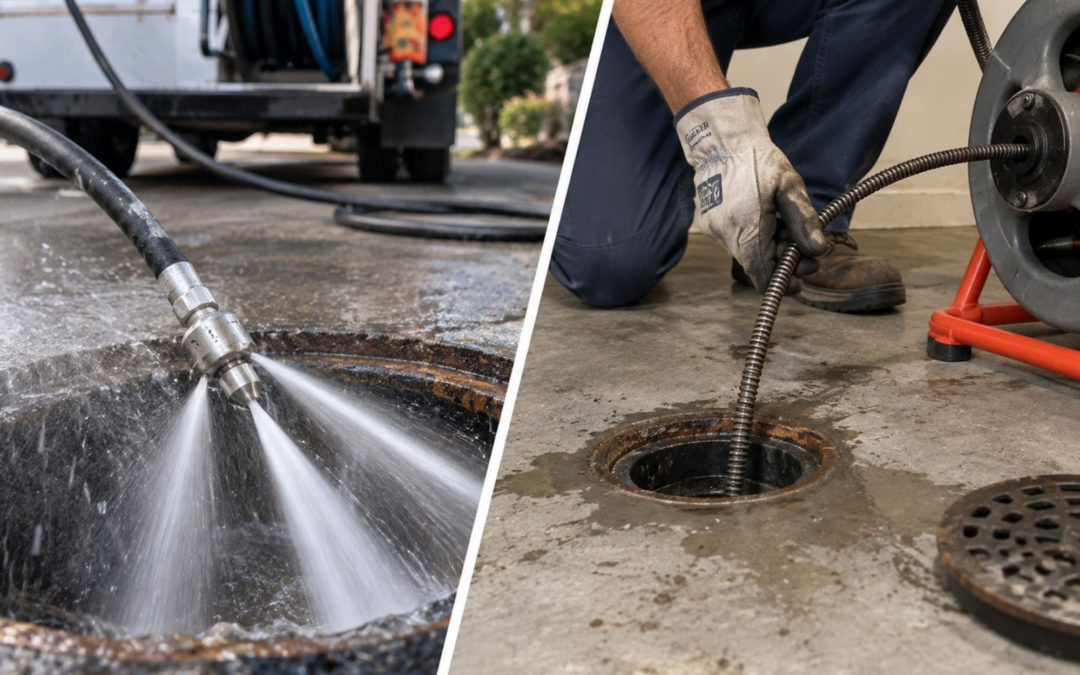
A clogged drain may come from one obstruction or from buildup that has collected along a larger section of pipe. That difference matters when comparing hydro jetting vs snaking because the two drain cleaning methods work in different ways.
Snaking uses a flexible cable and specialized attachment to reach or break through a blockage. Hydro jetting uses pressurized water to clean debris from more of the pipe interior. For homeowners in Jefferson Valley, the right approach depends on where the restriction is located, what is causing it, and the condition of the drain or sewer line.
Hydro Jetting vs Snaking
The main difference between hydro jetting and snaking is how each method clears a restriction. Snaking mechanically targets an obstruction with a flexible cable, while hydro jetting uses high-pressure water to loosen and flush material from a broader area inside the pipe. Neither method is automatically better for every drain issue.
| Factor | Drain Snaking | Hydro Jetting |
| Method | Flexible metal cable and attachment | Pressurized water and specialized nozzle |
| Best suited for | Localized obstructions | Widespread buildup |
| Pipe-wall cleaning | Limited | Broader cleaning |
| Common targets | Hair, objects, concentrated clogs | Grease, sludge, sediment, mineral buildup, some roots |
| Equipment | Plumbing auger or cable machine | Hydro jetting machine |
| Typical cost | Usually lower | Usually higher |
| Repairs damaged pipe | No | No |
Professional equipment reflects this difference. RIDGID drain-cleaning equipment includes plumbing augers, cable machines, cutters, and water jetting machines designed for different pipe sizes and types of obstructions.
How Drain Snaking Works
Drain snaking uses a flexible metal cable that a plumber feeds through a drain or sewer pipe. Different cutting or retrieval attachments can be fitted to the cable depending on the type of blockage. This makes snaking useful when the problem is concentrated in one location rather than spread across a long section of pipe.
Smaller augers may be used for sinks and bathroom drains, while larger cable machines can reach farther into a branch line or main sewer line.
Where Snaking Works Best
Snaking often works well for minor clogs and concentrated obstructions that can be broken apart, moved, cut, or retrieved mechanically. A single slow sink, shower, or tub may fit this pattern when the rest of the plumbing system drains normally.
Common examples include:
- Hair caught in a bathroom drain
- A foreign object lodged in a line
- A concentrated blockage near one fixture
- Material that can be cut mechanically
- An obstruction that can be retrieved with an appropriate attachment
When one identifiable blockage is responsible for the problem, mechanical cleaning may clear the clog without cleaning a much larger section of pipe.
Where Snaking Has Limits
A drain snake mainly works where the cable and attachment make contact. Snaking can restore flow through a clog while leaving grease, sludge, mineral scale, or other residue attached to the surrounding pipe wall.
That limitation matters when buildup has gradually narrowed the line. The drain opening may improve after mechanical cleaning, but the remaining material can still reduce the usable diameter of the pipe. In those cases, opening a path and cleaning the pipe interior are different goals.
How the Hydro Jetting Process Works
The hydro jetting process uses a hose and specialized nozzle to send pressurized water through a drain or sewer line. The water loosens debris and helps flush material farther through the sewer system rather than focusing only on one point of obstruction.
Some professional sewer jetters are rated at up to 4,000 PSI, but that does not mean every line receives the same water pressure. Pipe size, material, condition, water flow, nozzle selection, and the type of blockage all influence how the equipment is used. US Jetting professional equipment includes machines rated at 4,000 PSI for professional sewer line cleaning applications.
What Hydro Jetting Removes
Hydro jetting can remove grease, sludge, soap residue, sediment, mineral buildup, and mineral scale when those materials coat a larger portion of the pipe interior. It may also be used with specialized equipment for certain types of tree root intrusion.
This makes hydro jetting different from snaking. Unlike snaking, which mainly acts where a cable or cutter reaches the blockage, high-pressure water can work across more of the surrounding pipe surface. The result can be a more thorough cleaning when widespread buildup is actually the problem. That does not mean every slow drain needs hydro jetting; the method should match what is inside the line.
What Hydro Jetting Cannot Fix
Hydro jetting is a cleaning method, not a pipe repair method. It cannot reconnect separated pipe joints, correct an offset line, restore a collapsed pipe, or repair cracks. This distinction is particularly important with roots. Cleaning may remove root growth from inside the sewer line, but it does not repair the opening that allowed those roots to enter.
When Snaking Makes More Sense
Snaking is often the more practical choice when a drain clog appears to involve one localized obstruction. It allows a plumber to target the problem directly without automatically performing broader sewer line cleaning.
A single fixture that suddenly stops draining can fit this pattern, especially when the rest of the property’s drains work normally. Hair, food debris, soap residue, or an object caught in the line may be responsible.
Localized Blockages
Mechanical cleaning can be useful when something needs to be cut, broken apart, or retrieved. The attachment on the cable can be selected according to the pipe size and suspected obstruction.
If one compact blockage is causing the problem, a plumbing auger or cable machine may be enough to clear the clog. More extensive cleaning does not automatically provide an advantage.
When the Same Clog Returns
Recurring clogs deserve a closer look because they can indicate that the original problem extends beyond one small obstruction. The cause could be buildup farther along the line, another blockage downstream, tree roots, or a condition affecting the pipe itself.
Repeated snaking does not automatically mean hydro jetting should come next. It means the reason for the recurrence should be identified before choosing another cleaning method.
When Hydro Jetting Makes More Sense
Hydro jetting becomes more relevant when debris is spread across a larger section of the pipe. Grease, sludge, sediment, and mineral buildup can gradually narrow a kitchen drain, branch line, or main line even when water can still pass through the center.
It may also be considered when recurring clogs are linked to material that remains along the pipe walls after flow has been restored.
Grease and Heavy Buildup
Kitchen drains can collect grease and food residue over time. As that material sticks to the pipe wall, the opening becomes smaller and additional debris can collect more easily.
A snake may create a usable passage through the material. When the goal is to remove grease and other deposits from more of the pipe interior, hydro jetting may be the more suitable cleaning approach.
Tree Roots
Professional jetting equipment can also be configured for some tree root removal. US Jetting’s sewer jetting equipment includes machines and accessories designed for root-cutting and other difficult sewer blockages.
Root removal should not be confused with repair. Roots usually enter through an existing opening, so repeated intrusion may indicate a crack, loose joint, or other defect that still needs to be addressed.
What Drain Symptoms Can Tell You
Drain symptoms can provide clues about where a restriction may be located, but they cannot identify the exact cause on their own. The number of affected fixtures and the way they behave can help separate a localized clog from a larger drain or main sewer line problem.
A single slow drain is different from multiple slow drains, and that difference can help narrow the area that needs attention.
One Slow Drain
When only one sink, shower, or tub has slow drainage, the restriction may be close to that fixture or within its branch line. This pattern is more consistent with a localized problem when other fixtures continue to drain normally.
Hair, soap residue, food debris, or another compact obstruction may be involved. The actual blockage determines whether mechanical cleaning or another approach makes sense.
Multiple Slow Drains
When several drains slow down around the same time, the problem may be farther along the plumbing system rather than at one fixture. A restriction in a shared branch line or the main sewer line can affect multiple sinks, tubs, showers, or toilets at once.
Other signs of a larger drainage problem may include:
- Gurgling toilets when another fixture drains
- Water backing up into a nearby tub or shower
- A floor drain backing up during plumbing use
- Wastewater appearing at a low fixture
- Several drains losing flow at about the same time
These symptoms can point to a clogged sewer line or another restriction deeper in the system. If several fixtures are affected, professional plumbing service can help determine whether the blockage is in a branch line, main sewer line, or another part of the drainage system.
Why Pipe Condition Matters
Pipe condition affects which cleaning method may be appropriate, especially when high-pressure water is being considered. A sound pipe and a badly deteriorated pipe should not automatically receive the same treatment simply because both are clogged.
Pipe material also matters. Cast iron, clay, PVC, and other materials age differently, and their condition can vary based on corrosion, soil movement, installation quality, previous repairs, and years of use.
Older Pipes Are Not All the Same
Older pipes are not automatically fragile, and a newer line is not automatically free from defects. Two cast iron lines of the same age can have very different amounts of corrosion or deterioration.
That is why age alone is not enough to decide whether hydro jetting is safe for a particular line. The condition of the actual pipe matters more than a simple old-versus-new comparison.
Cleaning Cannot Repair Structural Damage
Cleaning removes material that restricts flow. It does not correct structural defects.
A cracked joint, collapsed section, displaced connection, or badly corroded pipe can continue causing trouble after a blockage has been removed. When structural damage is involved, additional cleaning does not repair the damaged area.
When a Sewer Camera Inspection Helps
A sewer camera inspection, sometimes called a video inspection, can provide useful information about an accessible drain or sewer line. When visibility allows, the camera may show buildup, roots, damaged areas, displaced joints, or other conditions that can affect the cleaning plan.
A professional camera inspection may be recommended before hydro jetting when the cause of the restriction or the condition of the pipe is uncertain. It is not automatically required before every hydro jetting job.
Reasons for Camera Inspection
A camera inspection may be useful when:
- The same main line repeatedly backs up
- Multiple drains are affected
- Tree roots are suspected
- The pipe’s condition is uncertain
- Previous cleaning did not solve the problem
- Structural damage may be present
The findings can help determine whether the problem appears to involve removable buildup or a pipe condition that deserves further evaluation.
Limits of Video Inspection
A sewer camera does not always provide a clear view of the full line. Heavy debris, standing water, a severe blockage, or limited access can prevent the camera from reaching or clearly showing some sections.
In some cases, enough of the blockage must first be removed to make the inspection useful. Camera inspection and professional cleaning may therefore happen at different stages of the same drain problem.
Hydro Jetting vs Snaking Cost
Hydro jetting is generally more expensive than straightforward snaking because it involves specialized pumps, hoses, nozzles, high-pressure water, and additional setup. Snaking uses simpler mechanical equipment and may require less preparation when the problem is a localized blockage.
Actual pricing varies by property and job conditions, so fixed national or out-of-state price ranges are not useful for estimating what a homeowner in Jefferson Valley will pay.
What Affects the Price
Several factors can change the cost of either method:
- Location of the obstruction
- Length of the affected pipe
- Pipe diameter
- Access to the drain or main line
- Severity of the blockage
- Equipment required
- Need for camera inspection
- Complexity of the plumbing system
A simple fixture clog usually involves a different level of work than a heavily restricted main sewer line.
Cost Should Match the Problem
Snaking can be a cost-effective option when one localized obstruction needs to be cleared. Paying for a more extensive cleaning process may provide little benefit if the rest of the pipe is already clear.
The reverse can also be true. When heavy buildup covers a larger section of the line, repeatedly creating a small path through that material may not address the condition affecting the pipe walls.
Can Hydro Jetting Prevent Future Clogs?
Hydro jetting can remove material that contributes to recurring restrictions, but it cannot guarantee that future clogs will not occur. How long a line remains clear depends on what caused the problem and whether that condition continues afterward.
A kitchen line affected by grease has a different recurrence risk from a sewer line affected by tree roots, damaged joints, mineral scale, or another structural problem.
Why Future Clogs Can Develop
Future clogs may be influenced by:
- Grease entering kitchen drains
- Tree root intrusion
- Pipe defects
- Mineral buildup
- Sediment
- Drainage layout
- Ongoing use of the plumbing system
For this reason, claims that hydro jetting always lasts two or three years are too specific. The useful question is not how long one cleaning method is supposed to last, but whether the cause of the restriction has actually been addressed.
When Professional Drain Cleaning Makes Sense
Professional cleaning may be appropriate when a drain problem goes beyond a minor clog that can be safely handled with basic homeowner methods. Repeated backups, multiple slow drains, or signs of a main sewer line restriction may require equipment and evaluation beyond a plunger or small hand auger.
A licensed plumber can assess where the restriction is likely located, what may be causing it, and whether pipe condition changes the available cleaning options.
Signs to Have the Problem Evaluated
Professional evaluation may make sense when:
- The same drain repeatedly clogs
- Multiple drains become slow at once
- Wastewater backs up into another fixture
- A main sewer line obstruction is suspected
- Basic plunging does not restore flow
- Tree roots may be present
- Previous cleaning provided only short-term relief
- There are concerns about older or damaged pipes
The goal is not simply to choose the strongest cleaning method. It is to identify what is restricting the system and choose an approach that fits the actual problem.
Choosing the Right Drain Cleaning Method
The hydro jetting vs snaking decision comes down to the type of blockage and the condition of the pipe. Snaking is often a good fit for a localized obstruction, while hydro jetting may make more sense when grease, sludge, mineral scale, or other buildup extends along a larger section of the line.
If recurring clogs, slow drains, or a sewer backup are affecting your Jefferson Valley property, a professional evaluation can help identify the cause and the right next step. Goldberg Plumbing & Heating can help assess the problem and explain the available options. Contact us to schedule an evaluation and get clear guidance based on the condition of your drain or sewer line.
FAQs
How much does it cost to hydrojet a sewer line?
Hydro jetting generally costs more than basic drain snaking because it requires specialized pumps, hoses, nozzles, water flow, and additional setup. Actual pricing depends on factors such as access, pipe length, blockage severity, equipment, and whether camera inspection is needed, so a property-specific evaluation is necessary for an accurate price.
Can snaking make a clog worse?
A drain that remains slow or becomes blocked again after snaking does not automatically mean the cable made the problem worse. Part of the obstruction may remain, material may still narrow the pipe, or another blockage may exist farther downstream, so continued symptoms are a reason to identify the cause rather than simply repeat the same cleaning method.
Is hydro jetting bad for pipes?
Hydro jetting can be safe for pipes that are in suitable condition when the equipment, water pressure, and nozzle are matched to the line. A cracked, collapsed, separated, or severely deteriorated pipe may require a different approach, which is why actual pipe condition matters more than whether the plumbing is simply described as old or new.
Is it better to plunge or snake a toilet?
A plunger is usually the first tool to try for a simple toilet clog near the fixture because it may move the obstruction without inserting equipment into the trap. If plunging does not work, a toilet auger can reach farther into the internal drain path, while repeated toilet clogs or problems affecting other fixtures can point to a restriction farther downstream.
Which is better for recurring clogs?
Hydro jetting may be more useful when recurring clogs are linked to grease, sludge, mineral buildup, or other material spread across the pipe walls, while snaking can still be appropriate when one specific obstruction needs to be removed mechanically. Because recurring clogs can also result from tree roots or damaged piping, the frequency of the problem alone does not determine which method should be used.
Can hydro jetting remove tree roots?
Certain professional hydro jetting machines and root-cutting nozzles can remove some tree root intrusion from sewer lines, but the right approach depends on the amount of root growth and the condition of the pipe. Removing roots can restore space inside the line, but it does not repair the crack, loose joint, or other opening that allowed them to enter.