
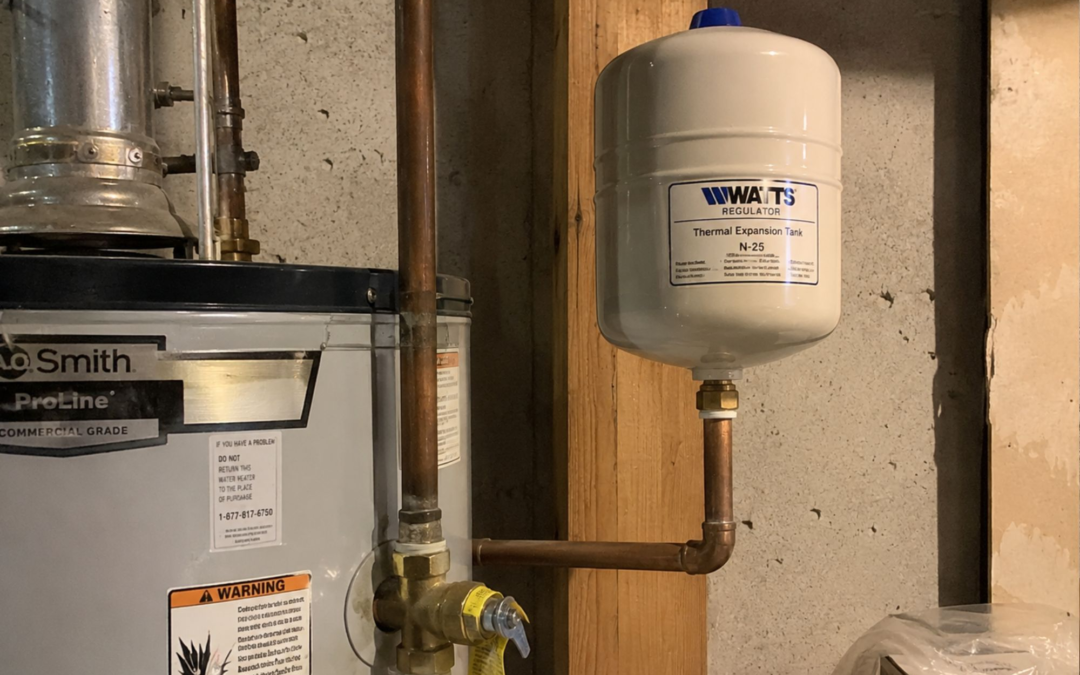
A water heater expansion tank gives heated water room to expand when your plumbing system does not allow that extra volume to move back toward the water supply. Without a way to control thermal expansion, pressure can rise each time a storage water heater heats a full tank of water.
For homeowners in Yorktown Heights, whether you need an expansion tank depends on the plumbing system, water pressure, installed valves, current code, and equipment requirements. Professional water heater and plumbing services can help determine whether the existing system has the right expansion-control setup before parts are replaced or added.
What Does a Water Heater Expansion Tank Do?
A water heater expansion tank absorbs the extra volume created as stored water heats and expands. Inside the tank, a flexible diaphragm or bladder separates water from a cushion of compressed air. That air space gives expanding water somewhere to move instead of allowing pressure to rise sharply in a closed plumbing system.
Water expands as its temperature increases. In some plumbing systems, the small increase in volume can move backward toward the water supply. In a closed system, however, a check valve, backflow preventer, pressure-reducing valve, or similar device may prevent that reverse flow.
The expansion tank is normally connected to the cold-water line serving the storage water heater. As water heats, some of the expanding volume moves into the tank and compresses the air on the other side of the diaphragm.
Expansion Tank vs. T&P Relief Valve
An expansion tank and a temperature-and-pressure, or T&P, relief valve perform different jobs. The expansion tank manages normal thermal expansion, while the T&P valve is a safety device designed to respond when temperature or pressure reaches unsafe conditions.
New York’s plumbing code states that the relief valve must not be used as the normal means of controlling thermal expansion. A properly designed expansion-control method addresses routine pressure changes before the relief valve needs to perform its safety function.
Do I Really Need an Expansion Tank on My Water Heater?
You may need an expansion tank when a storage water heater is connected to a closed plumbing system that prevents expanded water from flowing backward. The deciding factor is not simply the water heater’s age. Check valves, backflow devices, pressure-reducing valves, system pressure, and applicable code requirements all matter.
One of the first questions is whether the plumbing is an open or closed system. An open system provides a path for expanded water to move back toward the water supply. A closed system restricts that movement.
Common components that can create closed-system conditions include:
- Check valves
- Backflow prevention devices
- Certain pressure-reducing valve arrangements
- Other devices that prevent reverse flow
How Pressure-Reducing Valves Affect Thermal Expansion
A pressure-reducing valve controls excessive incoming water pressure, but it can also isolate the downstream plumbing from the supply. When that happens, heated water may have no path to expand backward.
High static water pressure and thermal expansion are related, but they are not the same issue. Static pressure is the pressure in the plumbing when water is not flowing. Thermal expansion pressure develops as water heats in a closed system.
For residential plumbing governed by the current New York Residential Code, static water pressure above 80 psi requires pressure reduction. The code addresses pressure caused by thermal expansion separately. If you are unsure whether your plumbing is closed, a licensed plumber can test the pressure and identify the valves and devices that affect expansion.
When Does New York Code Require Thermal Expansion Control?
New York code requires thermal expansion control under specific plumbing conditions rather than requiring the same expansion tank in every home. For storage water heaters, the key issue is whether devices such as a check valve, pressure-reducing valve, or backflow preventer can trap expanding water within the plumbing system.
The 2025 New York State Uniform Code became effective December 31, 2025, according to the New York Department of State. The exact requirement depends on which code provisions apply to the property and how the plumbing system is configured.
2025 New York Plumbing Code Requirements
For plumbing governed by the 2025 Plumbing Code of New York State, Section 607.3 addresses thermal expansion control. When a storage water heater receives cold water through a check valve, pressure-reducing valve, or backflow preventer, a thermal expansion control device must be connected to the cold-water supply downstream of those devices.
The code also states that an expansion tank used for this purpose must be sized according to the tank manufacturer’s instructions.
Residential Code Requirements
For homes governed by the 2025 Residential Code of New York State, thermal expansion is addressed in Section P2903.4. The requirements address pressure increases related to pressure-reducing valves, backflow prevention devices, check valves, and other conditions that restrict expansion.
This distinction matters: the code requires thermal expansion control in qualifying situations, not necessarily one specific expansion-tank model or size for every water heater. The correct solution can depend on the building, piping arrangement, installed valves, manufacturer requirements, and the code provisions that apply to the property.
How Is a Water Heater Expansion Tank Sized?
Expansion tank sizing is based on more than the gallon capacity of the water heater. Water-heater volume is one input, but system pressure, water temperature, tank pre-charge, and the expansion tank’s usable acceptance volume also affect the correct size. That is why manufacturer sizing information should be used instead of a universal rule of thumb.
You may see broad statements that most homes use a two- to five-gallon expansion tank. That range may describe common products, but it does not tell you what a specific plumbing system needs.
Manufacturers such as Watts provide sizing tools that account for factors including:
- Water heater capacity
- Initial water temperature
- Final water temperature
- System pressure
- Expansion tank air pre-charge
- Tank acceptance volume
What Size Expansion Tank Do I Need for a 50-Gallon Water Heater?
A 50-gallon water heater does not automatically require one particular expansion-tank size. The heater’s capacity provides a starting point, but household water pressure and temperature conditions influence how much expanded water the tank needs to accept.
The New York Plumbing Code specifically requires expansion tanks used for thermal expansion control to be sized according to manufacturer instructions. A plumber may measure the home’s static water pressure and then use the selected manufacturer’s sizing chart or calculator.
This is more reliable than choosing a tank solely because the package says it is commonly used with a 40- or 50-gallon water heater.
Why Does Expansion Tank Pre-Charge Matter?
The air pre-charge determines how the expansion tank responds to water entering it. For the tank to work as intended, the pre-charge must be set according to the system conditions and manufacturer’s instructions. Factory pressure is only a starting point and should not automatically be assumed to match the home’s water pressure.
The expansion tank has water on one side of its diaphragm and compressed air on the other. If the relationship between system pressure and air pressure is incorrect, the tank may not have the intended amount of usable space for expanding water.
Because the tank is a pressurized vessel, pressure adjustment and installation should follow manufacturer safety instructions.
Factory Pre-Charge Is Not a Universal Setting
Some online guidance states that expansion tanks are commonly pre-charged to 20 psi. That should not be treated as a universal setting. Different manufacturers and product lines use different factory pre-charge pressures.
Expansion tank manufacturers, including Amtrol publish model-specific pressure and installation information. The correct adjustment should follow the instructions for the exact tank being installed.
Checking pre-charge also requires the correct testing conditions. Manufacturer procedures commonly require relieving water-side pressure before an accurate air-side measurement or adjustment can be made. If you do not know the system pressure or required setting, professional testing is preferable to guessing.
What Are Signs an Expansion Tank May Need Attention?
Visible leakage, corrosion, unusual pressure changes, or repeated discharge from the water heater’s T&P relief valve are reasons to have the system inspected. None of those symptoms proves that the expansion tank itself has failed. Other pressure-control components, incorrect pre-charge, excessive incoming pressure, or relief-valve problems can produce similar signs.
Possible reasons to schedule an inspection include:
- Water leaking from the expansion tank or its connection
- Visible corrosion around the tank or fittings
- A tank that cannot maintain the specified air charge
- Noticeable changes in plumbing pressure
- Repeated discharge from the water heater’s relief valve
- An expansion tank with unknown condition or setup
A dripping T&P relief valve should not be plugged, capped, or disabled. The New York Plumbing Code’s water-heater provisions require relief protection for pressurized storage water heaters and make clear that the relief valve is not a substitute for thermal expansion control.
How Often Should an Expansion Tank Be Replaced?
There is no single replacement schedule that applies to every water heater expansion tank. Although five-to-ten-year lifespan estimates appear in general consumer guidance, actual service life can vary with tank construction, water conditions, pressure cycles, installation, and system operation.
A better approach is to evaluate the tank’s condition and ability to hold the required air charge rather than replace it based only on age. Leakage, corrosion, or testing that shows the tank cannot maintain its required charge may indicate that replacement is appropriate.
What Should a Plumber Check?
A proper expansion-tank evaluation looks at the plumbing system as a whole. The plumber should determine whether the system is closed, measure water pressure, identify pressure-reducing or backflow devices, inspect the existing expansion tank, and compare its size and pre-charge with the applicable manufacturer’s requirements.
A useful evaluation may include checking:
| Item | Why It Matters |
| Static water pressure | Helps identify pressure conditions and sizing inputs |
| Check valves or backflow devices | May create a closed plumbing system |
| Pressure-reducing valve | Can affect both static pressure and thermal expansion |
| Water heater capacity | Used as part of expansion-tank sizing |
| Expansion tank size | Must provide enough usable acceptance volume |
| Air pre-charge | Needs to be set for the system and tank requirements |
| Tank and fittings | Leakage or corrosion may indicate repair or replacement is needed |
Why the Whole Plumbing System Matters
The goal is to identify the source of the pressure issue before recommending a repair. A leaking fitting, incorrect pressure setting, failed tank, or unrelated plumbing problem may call for different work.
Professional water heater services can include evaluating the water heater, nearby piping, pressure-control components, and thermal expansion setup when repair or replacement is being considered.
Get the Water Heater Expansion Setup Checked
A water heater expansion tank has a simple purpose, but deciding whether you need one requires more than looking at the water heater. The plumbing system must be checked for closed-system conditions, water pressure, thermal expansion control, proper sizing, and the manufacturer’s installation requirements.
If you need help with an existing expansion tank, water heater, or pressure concern in Yorktown Heights, contact Goldberg Plumbing & Heating. Goldberg is a second-generation, family-owned company serving Northern Westchester and Putnam Counties for more than 40 years. Its licensed professionals can inspect the plumbing, explain what the system requires, and recommend an appropriate next step without unnecessary upselling.
FAQs
Do I really need an expansion tank on my water heater?
You may need an expansion tank if your storage water heater is part of a closed plumbing system where expanded water cannot move back toward the supply. Check valves, backflow preventers, and some pressure-reducing valve arrangements can create those conditions. Current New York code requires thermal expansion control in specified situations, but the appropriate method depends on the system.
What does a water heater expansion tank do?
A water heater expansion tank provides space for the additional water volume created as stored water heats. The tank contains an air cushion separated from the water by a flexible diaphragm or bladder. As heated water expands, it can move into the tank rather than causing the same pressure increase within the closed plumbing system.
What size expansion tank do I need for a 50-gallon gas water heater?
There is no single expansion-tank size that is correct for every 50-gallon water heater. Proper sizing also considers system pressure, temperature conditions, tank pre-charge, and the manufacturer’s rated acceptance volume. Use the expansion tank manufacturer’s sizing chart or calculator based on actual system conditions rather than heater capacity alone.
How often do you change an expansion tank on a water heater?
Expansion tanks do not have one universal replacement interval. Their condition depends on factors such as pressure cycles, installation, tank construction, and whether the diaphragm and air charge remain functional. Leakage, corrosion, or testing that confirms the tank cannot maintain the required charge may indicate that replacement is appropriate.
Can a bad expansion tank cause the relief valve to drip?
A failed or incorrectly set expansion tank can contribute to pressure increases that may be associated with relief-valve discharge, but a dripping T&P valve does not prove the expansion tank is the cause. Excessive static pressure, the relief valve itself, temperature conditions, or other plumbing components may also be involved. The system should be tested rather than diagnosed from the symptom alone.