
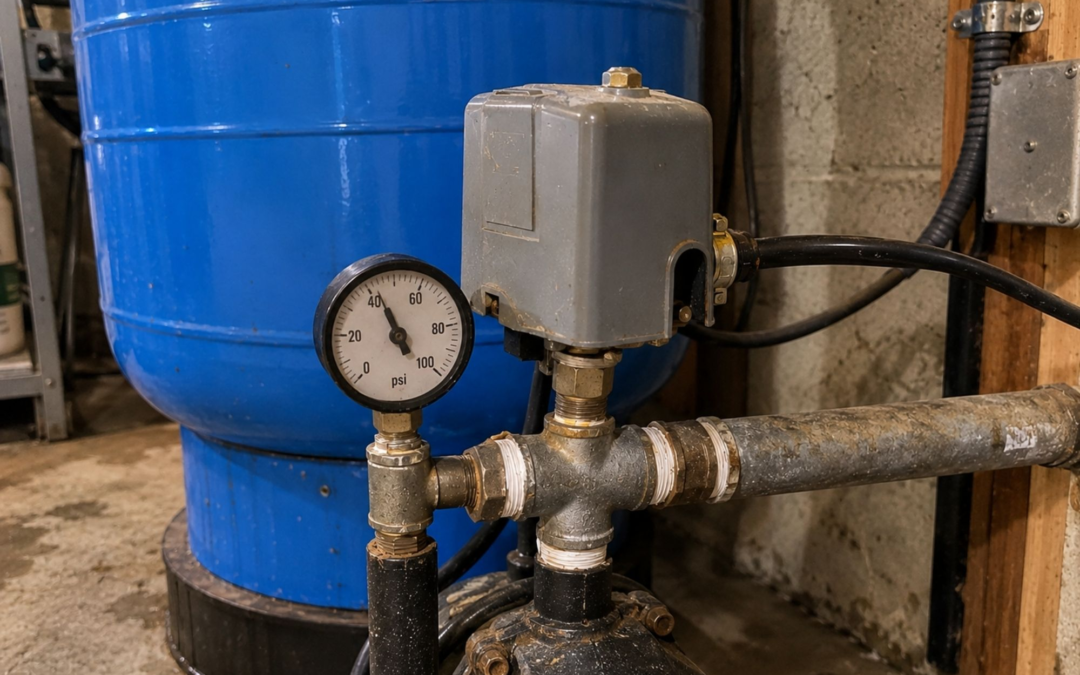
Changes in water pressure can make it seem like the well pump pressure switch has failed. Your pump may cycle repeatedly, refuse to start, keep running, or turn on at a pressure that does not seem right. For homeowners in Mahopac, these symptoms are worth checking, but they do not automatically mean the pressure switch needs replacement.
The pressure switch works with the well pump, pressure tank, gauge, piping, and electrical controls. A problem with any of these parts can produce similar symptoms. Understanding how the system works can help you recognize warning signs, avoid replacing a working part, and know when the whole well system needs closer inspection.
What Does a Well Pump Pressure Switch Do?
A well pump pressure switch starts and stops the pump according to water pressure in the system. When pressure falls to the switch’s cut-in setting, the pump starts. When pressure rises to the cut-out setting, the switch stops the pump. This cycle provides usable water pressure without requiring the pump to run continuously.
How the Switch, Pump, and Pressure Tank Work Together
When you open a faucet or take a shower, stored water leaves the pressure tank and system pressure begins to fall. Once pressure reaches the cut-in point, the pressure switch closes its electrical contacts so the pump can run. The pump then sends more water into the system until pressure reaches the switch’s cut-out setting and the pump stops.
Common residential pressure switch configurations include 20/40, 30/50, and 40/60 PSI. The first number represents the approximate pressure at which the pump starts, while the second represents the pressure at which it stops. Pentair currently lists these three pressure ranges for residential well-system pressure switches and specifies a 20 PSI differential on the referenced product line.
The pressure tank also plays an important part in this cycle because it stores water under pressure between pump starts. That stored water keeps the pump from starting whenever a small amount of water is used. Problems with the tank, switch, gauge, or pump can change the normal cycle, which is why one symptom rarely identifies the failed component by itself.
Symptoms of a Bad Well Pump Pressure Switch
Possible symptoms of a bad well pump pressure switch include a pump that will not start, will not shut off, cycles unexpectedly, or operates outside its expected pressure range. Repeated clicking or visible deterioration around the switch may also point toward a problem. These signs still require investigation because other parts of the well system can cause nearly identical behavior.
The pressure gauge provides useful context because it shows what the water pressure is doing when the pump starts and stops. A pump that does not start after pressure falls below its normal cut-in setting could involve the switch, but the electrical supply, sensing connection, wiring, or pump may also be responsible. A pump that keeps running may simply be unable to build enough pressure to reach its cut-out point.
| What you notice | Possible explanations |
| Pump does not start at low pressure | Pressure switch, electrical supply, wiring, blocked sensing connection, or pump problem |
| Pump keeps running | Switch problem, leak, water-supply issue, pump problem, or inability to reach cut-out pressure |
| Pump turns on and off rapidly | Pressure tank, tank precharge, pressure settings, system demand, or switch problem |
| Repeated clicking or chatter | Changing pressure, tank issue, electrical contacts, or pressure-sensing problem |
| Gauge does not match expected settings | Switch adjustment, inaccurate gauge, restriction, or another system problem |
| Visible damaged contacts | Damaged electrical components found during inspection | Switch or electrical damage requiring professional evaluation |
Why the Pressure Switch May Not Be the Actual Problem
Rapid cycling is one of the best examples of why symptoms alone should not be treated as a diagnosis. A pressure tank that has lost usable air volume can cause the pump to start and stop much more frequently. Incorrect tank precharge, pressure-switch settings, system demand, and tank sizing can also influence pump cycling. Amtrol identifies rapid cycling and low pressure among warning signs that may indicate a pressure-tank problem.
If your pump is cycling rapidly or water pressure keeps rising and falling, it is useful to understand the possible well pressure tank problems that can produce symptoms similar to a faulty pressure switch. Looking at the tank, switch, pump, and pressure readings together gives a clearer picture than replacing the switch based on clicking or short cycling alone.
30/50 vs. 40/60 Well Pump Pressure Switches
Neither a 30/50 nor a 40/60 well pump pressure switch is automatically better. The appropriate pressure range depends on the pump’s capabilities, pressure tank, plumbing system, water demand, and manufacturer requirements. A 40/60 setup operates at higher pressure, but every part of the system must be able to work correctly at those settings.
A 30/50 switch normally starts the pump near 30 PSI and stops it near 50 PSI. A 40/60 switch performs the same job at approximately 40 and 60 PSI. Pentair lists residential well-system switches in 20/40, 30/50, and 40/60 configurations, so the setting should be treated as part of the overall system design rather than a simple upgrade choice.
| Switch setting | Pump starts around | Pump stops around | Typical tank precharge* |
| 30/50 PSI | 30 PSI | 50 PSI | 28 PSI |
| 40/60 PSI | 40 PSI | 60 PSI | 38 PSI |
Amtrol well-tank precharge guidance specifies setting tank precharge 2 PSI below the pressure switch cut-in setting when the tank is checked under the manufacturer’s required conditions.
Why Higher Pressure Is Not Always the Right Fix
Moving from a 30/50 to a 40/60 setting can increase the operating pressure range, but that does not mean every well system should be changed. The pump must be capable of reaching the higher cut-out pressure while supplying the property normally. The tank precharge must also correspond with the new cut-in setting.
Changing only the pressure switch can create new problems when the pump or tank is not suited to the higher setting. If weak water pressure is the original complaint, restrictions, pump condition, system demand, treatment equipment, or another cause may need attention first. The right pressure setting is the one that works with the entire system rather than simply producing the highest gauge reading.
How to Check a Well Pump Pressure Switch Problem
Checking a possible pressure switch problem starts with observing how the pump and pressure gauge behave through a complete cycle. Note the pressure where the pump starts, the pressure where it stops, and whether it reaches those points smoothly. Those observations can help separate a switch problem from an issue involving the pressure tank, pump, gauge, or water supply.
Start With the Pressure Gauge
Watch the pressure gauge while water is being used. System pressure should generally fall toward the cut-in setting before the pump starts, then rise while the pump runs until it reaches the cut-out setting. If pump operation does not correspond with the expected readings, the pressure-control system deserves closer inspection.
Do not assume the switch has failed simply because household pressure feels weak. If the pump starts and stops around its intended settings, the switch may be responding correctly while another part of the water system affects flow or pressure at the fixtures. Comparing pump behavior with gauge readings provides more useful information than judging the switch from shower pressure alone.
Check the Pressure Tank Relationship
The pressure tank and switch need to work together. For applicable well tanks, Amtrol specifies setting tank precharge 2 PSI below the pressure switch’s cut-in setting, with the tank properly drained of water pressure before the air charge is checked. That means a common 30/50 system may use a 28 PSI precharge, while a 40/60 system may use 38 PSI.
If the tank is older, visibly damaged, leaking, or shows signs of deterioration, do not simply add air and return it to service. A compromised pressure tank should be professionally evaluated before repressurizing it.
Be Careful With Electrical Testing
The pressure switch controls electrical power to the pump. Disconnect power to the pump before removing the pressure-switch cover or touching any components. Because electrical testing may involve hazardous voltage and results depend on the switch position, circuit design, wiring, and manufacturer’s procedure, electrical diagnosis is best left to a qualified professional.
If checking the pressure cycle does not reveal the problem, professional testing can determine whether the switch is receiving and transferring power as intended. It can also help identify burned contacts, wiring problems, restrictions in the pressure-sensing connection, or another condition that may look like switch failure.
Can You Reset or Adjust a Well Pressure Switch?
Some well pressure switches are adjustable, while certain models also include a low-pressure cutoff and manual reset feature. These functions are not present or operated the same way on every switch. Before trying to reset or adjust one, identify the exact model and determine why the pump stopped or the pressure changed.
A low-pressure cutoff is designed to respond when system pressure drops well below the normal operating range. Pentair, for example, offers certain residential pressure switches with a low-pressure cutoff, while other versions do not include the feature. That means instructions for resetting one switch should not automatically be applied to another model.
Why Pressure Adjustments Require Care
Many mechanical well pressure switches use internal springs and adjustment nuts to change operating settings. Turning an adjustment changes when the pump starts, stops, or both, depending on the switch design. The adjustment procedure should therefore follow the instructions for the specific switch instead of a generic number of clockwise turns.
The pump, pressure tank, piping, fixtures, and controls must also be suitable for the resulting operating pressure. If the original problem is rapid cycling, low pressure, or a pump that keeps running, changing the setting before identifying the cause may hide one symptom while leaving the actual problem unresolved.
When Should a Well Pump Pressure Switch Be Replaced?
A well pump pressure switch should be replaced when inspection confirms that the switch is damaged, unreliable, or no longer controlling the pump correctly. Before replacement, other likely causes should be checked because pressure-tank, gauge, pump, wiring, sensing-port, and water-supply problems can produce many of the same symptoms.
Visible deterioration may support a replacement decision, particularly when the electrical contacts or internal mechanism are damaged. However, installing a new switch will not correct a pump that cannot build enough pressure, a pressure tank that is not operating correctly, or a restricted connection that prevents the switch from sensing system pressure accurately.
What a Replacement Switch Needs to Match
The replacement switch needs to suit the pump and water system rather than simply looking like the old switch. Important considerations include the required pressure range, electrical rating, connection type, pump specifications, and whether the system uses a low-pressure cutoff feature. Manufacturers offer several configurations because different well systems have different operating requirements.
The pressure tank must also be considered when the cut-in setting changes. Since tank precharge commonly relates to the switch’s cut-in pressure, changing from one pressure range to another can require corresponding system adjustments. Matching all of these components helps the pump complete normal cycles rather than solving one problem while creating another.
Get the Well System Checked Before Replacing Parts
A pressure switch is only one part of a well water system, so a good repair starts by confirming what the entire system is doing. Checking cut-in and cut-out behavior, pressure-tank condition, gauge readings, pump performance, and the pressure-sensing connection can help prevent unnecessary parts replacement and reveal problems that a new switch would not correct.
If your well pump is cycling strangely, losing pressure, or failing to start or stop as expected, Goldberg Plumbing & Heating can evaluate the well pump, pressure tank, pressure switch, and related water-system controls in Mahopac. Contact us to schedule a professional evaluation and determine whether the system needs an adjustment, repair, or pressure-switch replacement.
FAQs
How can you tell if a well pump pressure switch is bad?
A bad pressure switch may cause the pump to fail to start when pressure reaches its cut-in setting, fail to stop after cut-out pressure is reached, or operate inconsistently through normal pressure changes. Damaged contacts or other visible deterioration can provide additional clues. However, similar symptoms can come from the tank, pump, wiring, pressure gauge, sensing connection, or water supply, so the complete system should be considered.
Which is better, a 30/50 or 40/60 pressure switch?
Neither pressure switch is better for every home. A 30/50 switch starts and stops the pump at lower pressures, while a 40/60 switch maintains a higher operating range. Pump capacity, tank setup, plumbing requirements, fixture needs, and equipment specifications determine which range is appropriate for a particular system.
How do I reset the pressure switch on a well pump?
Not every well pressure switch has a manual reset function. Low-pressure-cutoff models may use a reset mechanism after system pressure falls below a specified level, while ordinary pressure switches may not include that feature at all. Identify the exact switch model before attempting a reset, and investigate why pressure dropped instead of repeatedly resetting a protective cutoff.
What are the symptoms of a faulty pressure switch?
Possible symptoms of a bad well pump pressure switch include a pump that will not start, will not shut off, cycles unexpectedly, or operates outside its expected pressure range. Repeated clicking or other unusual switch behavior may also indicate a problem, but these symptoms do not confirm that the switch itself has failed.
Can a bad pressure tank look like a bad pressure switch?
Yes, a pressure tank problem can easily resemble a faulty pressure switch. Loss of usable air volume or incorrect tank precharge may contribute to rapid pump cycling, changing pressure, and frequent switch operation. Amtrol specifically identifies rapid cycling and low pressure as possible pressure-tank warning signs, making tank condition an important part of pressure-switch troubleshooting.
Does a replacement well pressure switch need the same setting?
A replacement should match the operating requirements of the pump and the overall water system rather than being chosen from pressure numbers alone. If a different cut-in and cut-out range is being considered, pump capability and pressure-tank setup also need to be evaluated. Raising the cut-out setting can create problems if the pump cannot reliably reach that pressure during normal operation.