
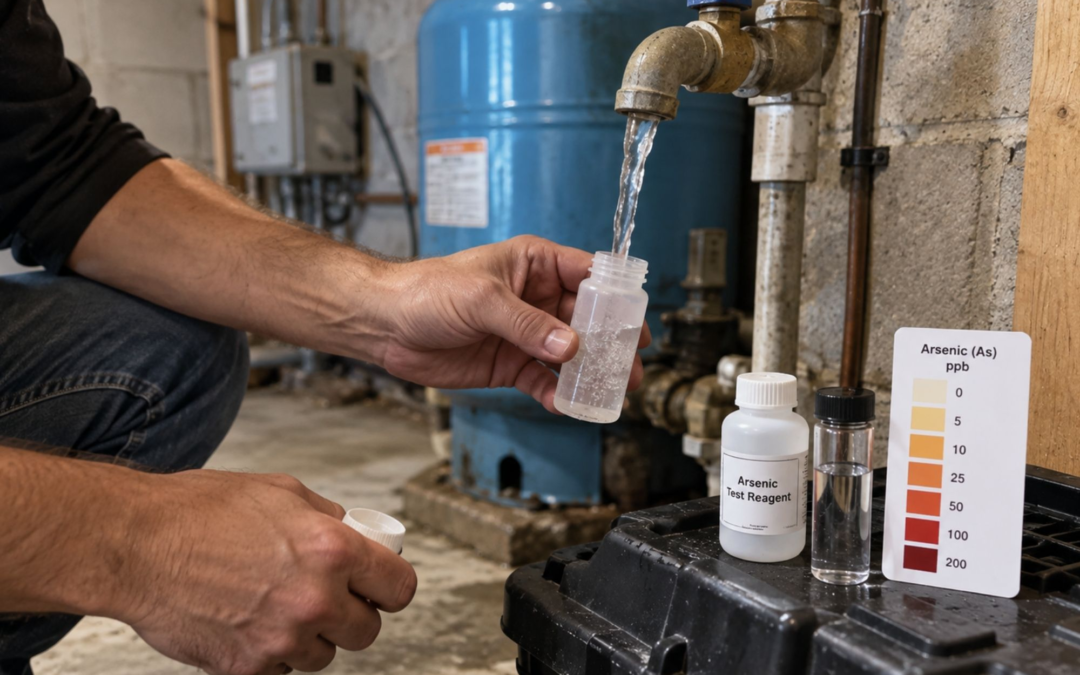
Arsenic in well water can be hard to recognize because you usually cannot see, smell, or taste it. For homeowners with private wells in Putnam County, testing is the only reliable way to know how much arsenic is in the water and whether action may be needed.
If your well has not been tested recently, or a laboratory result shows elevated arsenic, start with a professional water system analysis before choosing treatment equipment. The right approach depends on the test result, the form of arsenic, and the chemistry of the water.
What Causes Arsenic in Well Water?
Arsenic is a naturally occurring element found in rocks, soil, and groundwater. In New York, arsenic in surrounding bedrock or other geological material can dissolve into groundwater and reach a private well. Its concentration can vary from one well to another, even when the wells are located relatively close together.
Natural geology is an important source of arsenic in private well water. Human activities, including some industrial and agricultural practices, can also contribute arsenic to the environment.
That variation is why a county risk map or a neighbor’s test result cannot tell you what is in your own well. Local risk information can help identify reasons to test, but a laboratory analysis of water from your property provides the information needed for treatment decisions.
Health Risks of Long-Term Arsenic Exposure
The main health concern with arsenic-contaminated well water is long-term ingestion. Health effects depend on the arsenic level, duration of exposure, and individual sensitivity. According to the Agency for Toxic Substances and Disease Registry (ATSDR), long-term exposure to inorganic arsenic has been linked to skin changes, cardiovascular disease, type 2 diabetes, developmental effects, and increased risks of lung, bladder, and nonmelanoma skin cancers.
Drinking water mainly contains inorganic arsenic, which is generally more toxic than organic forms found in some foods. If you are concerned about possible exposure, speak with a qualified healthcare professional. A water test can measure arsenic in the well, but it cannot diagnose a medical condition.
What Arsenic Level Is Too High in Well Water?
The EPA drinking-water standard for arsenic in regulated public water systems is 10 micrograms per liter (µg/L), or 10 parts per billion (ppb). New York also uses 0.01 mg/L, which equals 10 µg/L, as an important arsenic benchmark for drinking water.
The 10 ppb figure is a useful drinking-water and treatment benchmark. It should not be interpreted as a point where all risk suddenly begins or disappears. Instead, it gives homeowners and water professionals a recognized reference when reviewing laboratory results.
Private household wells differ from community water systems. Public water systems must meet federal monitoring and drinking-water requirements, while private-well owners are responsible for monitoring their own water. Learning more about general well water safety can also help homeowners understand when testing and treatment may be needed.
How Often Should You Test for Arsenic?
The NYSDOH recommends testing private well water every year for bacteria and every three to five years for arsenic and several other contaminants. Additional testing may make sense after flooding, changes to the well or water system, changes in nearby land use, or other concerns about local contamination.
New residential wells should also be tested for arsenic before regular household use. Using an approved drinking-water laboratory helps provide reliable results for treatment decisions.
Do not select an arsenic filter based only on a county estimate or an old test result. Current laboratory results give a water-treatment professional a better basis for evaluating what treatment, if any, is appropriate.
What Should You Do if Your Well Tests High for Arsenic?
If testing shows arsenic at a level of concern, reduce ingestion first and then investigate treatment. Use an alternate suitable water source for drinking, preparing food, and making ice while the result is being evaluated and the appropriate treatment approach is determined.
A practical next-step sequence is:
- Review the laboratory report. Confirm the arsenic concentration and units.
- Use suitable alternate water for drinking and food preparation while the result is being evaluated.
- Assess the water chemistry. Arsenic form, pH, minerals, iron, and other characteristics may affect treatment.
- Choose treatment based on the test results, not simply on a product label or general recommendation.
- Retest the treated water to confirm that the system is reducing arsenic as intended.
If a result is elevated, arrange a water-system evaluation before purchasing equipment. Treatment that works well for one well may not be the right match for another.
Arsenic Treatment Options for Private Wells
Arsenic can often be reduced with treatment, but there is no single system that is right for every private well. Reverse osmosis, adsorptive media, and anion exchange are among the available approaches. The most suitable option depends on arsenic concentration and form, other water-quality conditions, where treatment is needed, and system maintenance requirements.
One important factor is arsenic chemistry. Arsenic III, or arsenite, is generally harder to remove than arsenic V, or arsenate. Some wells may need oxidation or another pretreatment step before the main arsenic-removal process can work effectively.
| Treatment Method | Typical Use | Main Benefit | Important Consideration |
| Reverse osmosis | Often point-of-use drinking and cooking water | Can reduce arsenic when properly selected | Performance depends on arsenic form, water chemistry, and the specific system |
| Adsorptive media | Point-of-use or larger treatment applications | Specialized media captures arsenic as water passes through | Media life depends on water chemistry, arsenic level, and water use |
| Anion exchange | Can be used for larger-volume treatment | Can reduce arsenic V under suitable conditions | Arsenic III and competing ions may require pretreatment or another approach |
Reverse Osmosis
Reverse osmosis, or RO, pushes water through a membrane that separates many dissolved contaminants from the treated water. It is commonly used as a point-of-use system for water intended for drinking and cooking.
Not every RO system has been tested for arsenic reduction. Under NSF/ANSI 58, arsenic reduction is an optional contaminant-reduction claim rather than a requirement for every certified RO system. Check that the specific system has an applicable arsenic-reduction claim instead of relying on the words “reverse osmosis” alone.
Adsorptive Media
Adsorptive treatment uses specialized media that binds arsenic as water flows through it. Metal oxide media are one example. These systems may work well under suitable water conditions, but media capacity and replacement needs can change based on arsenic concentration, pH, competing substances, and total water use.
For that reason, a fixed replacement schedule should not be assumed without considering the manufacturer’s requirements and follow-up testing.
Anion Exchange
Anion exchange uses charged media to remove certain dissolved substances from water. It can be effective for arsenic V under suitable conditions, while arsenic III can be more difficult to address. Pretreatment may therefore be needed in some installations.
Water chemistry also matters because other substances can affect treatment performance. System design should be based on laboratory results rather than arsenic concentration alone.
Can You Shower or Boil Water With Arsenic?
Drinking and cooking are the main household exposure concerns when arsenic is present in well water. Arsenic does not readily pass through intact skin or evaporate from household water, so showering and bathing generally contribute far less exposure than swallowing the water. Boiling, however, does not remove arsenic.
The focus should be on water used for drinking, cooking, brushing teeth, food preparation, and other activities that can result in ingestion.
Boiling is useful for addressing some biological contaminants, but arsenic is a chemical contaminant. Boiling does not destroy or filter it out. As water evaporates, the arsenic remains behind, so boiling should not be used as an arsenic-treatment method.
How Do You Know an Arsenic Treatment System Is Working?
A treatment system should be verified with water testing after installation rather than judged by taste, appearance, or equipment operation alone. Follow-up laboratory results show whether the selected treatment is reducing arsenic under the actual conditions in your home.
Filters, membranes, and treatment media do not last forever. Follow the manufacturer’s maintenance instructions and keep records of service and water-test results. A maintenance plan should reflect the treatment equipment, household water use, and test results.
Retesting is especially important after media replacement, equipment changes, or any result that raises questions about treatment performance.
Protect Your Well Water With Testing and the Right Treatment
Arsenic in a private well cannot be judged by taste, smell, appearance, or a neighbor’s test result. Putnam County homeowners can make better decisions by testing their own water, reviewing the arsenic concentration and overall water chemistry, reducing ingestion when a result is elevated, and verifying any treatment system with follow-up laboratory testing.
Goldberg Plumbing & Heating can help evaluate well-water concerns and recommend treatment based on test results. Contact us to schedule an evaluation if arsenic is found in your well.
FAQs
Can arsenic be removed from a well?
Arsenic can often be reduced in the water supplied by a private well through treatments such as reverse osmosis, adsorptive media, and anion exchange. Treatment does not remove arsenic from the underground aquifer itself. The right system should be chosen after testing because arsenic concentration, arsenic form, pH, iron, and other water-quality conditions can affect treatment performance. Follow-up testing is needed to confirm that the system is reducing arsenic as intended.
How serious is arsenic in well water?
Arsenic in well water can be a serious concern when people ingest elevated levels over a long period. Long-term exposure to inorganic arsenic has been associated with skin changes, cardiovascular disease, type 2 diabetes, developmental effects, and increased risks of certain cancers. Because arsenic usually cannot be detected by taste, smell, or appearance, laboratory testing is the reliable way to determine the arsenic level in a private well.
Where does arsenic come from in a well?
Arsenic in a private well commonly comes from naturally occurring arsenic in rocks, soil, and other geological material. As groundwater moves through these materials, arsenic can dissolve into the water and eventually reach the well. Industrial and agricultural activities can also contribute arsenic to the environment, which is why arsenic levels can vary between wells even within the same area.