
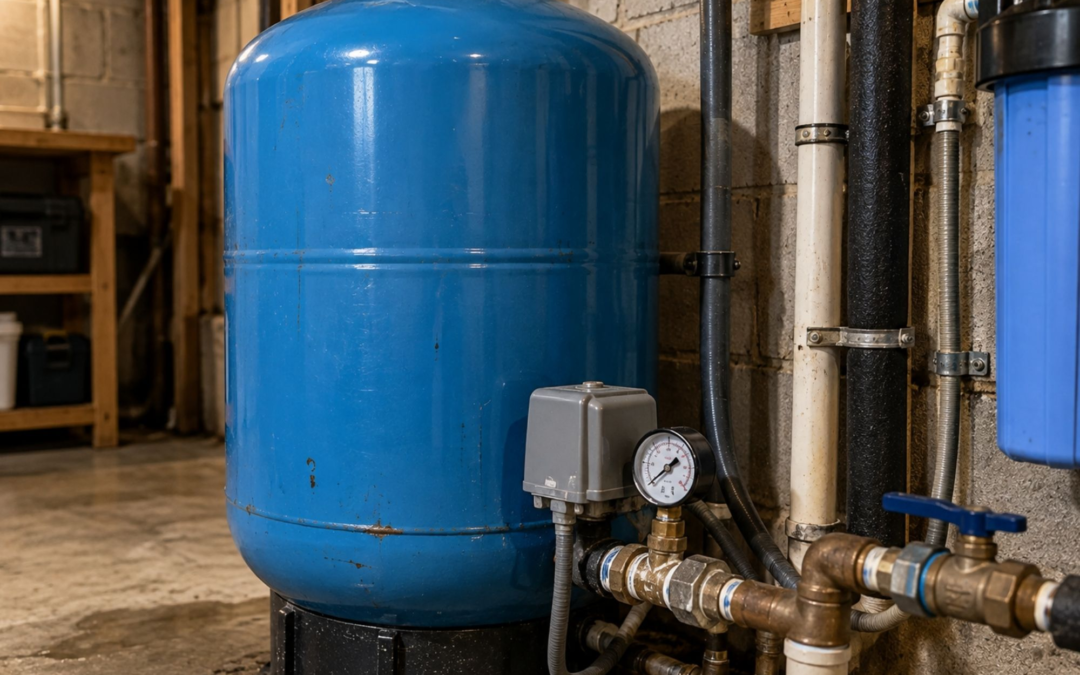
If your well pump turns on every few seconds, your shower pressure rises and falls, or the pressure switch keeps clicking, the problem may be somewhere in the pressure side of the well system. Well pressure tank problems are a common reason for short cycling and unstable water pressure, but those symptoms do not always mean the tank itself has failed.
For homeowners in Mahopac, a careful check can help separate a low air charge from a damaged bladder, faulty pressure switch, leak, or pump problem. If the pump is cycling rapidly or pressure keeps changing, schedule a professional well-system evaluation before replacing parts.
What Does a Well Pressure Tank Do?
A well pressure tank stores pressurized water and maintains an air cushion so the pump does not need to start every time you open a faucet. As water leaves the tank, pressure falls until it reaches the pressure switch cut-in setting. The pump then turns on, refills the tank, and stops when pressure reaches the cut-out setting.
The tank works with the well pump, pressure switch, pressure gauge, check valve, and household piping. Compressed air helps push stored water into the plumbing between pump cycles, providing steadier pressure while reducing unnecessary pump starts. The usable amount of water supplied between pump cycles is called drawdown.
When the tank loses its proper air charge or an internal bladder fails, that drawdown can decrease. The result may be more frequent pump cycling, pressure fluctuations, or other changes in how the well system operates.
Common Well Pressure Tank Problems and Symptoms
Common well pressure tank problems include incorrect air pressure, waterlogging, bladder or diaphragm failure, corrosion, and problems that appear to involve the tank but originate elsewhere. Short cycling, fluctuating water pressure, repeated pressure-switch clicking, reduced drawdown, and water coming from a bladder tank’s air valve deserve further investigation.
One symptom alone does not confirm that the pressure tank needs replacement. Problems with the pressure switch, pump, check valve, plumbing, or well supply can produce similar behavior.
| What You Notice | Possible Cause | What It May Mean |
| Pump starts and stops every few seconds | Low air charge, waterlogged tank, bladder failure, switch issue | The system is losing pressure or usable drawdown too quickly |
| Water pressure rises and falls | Incorrect air charge, bladder problem, switch issue | Pressure may not be balanced correctly |
| Pressure switch clicks rapidly | Short cycling | Pressure is moving through the cut-in and cut-out range too quickly |
| Water comes from the tank air valve | Internal bladder or diaphragm failure | Water has entered the air side of the tank |
| Pump runs constantly | Leak, pump problem, low well yield, check valve issue, or controls | The system may not be reaching its cut-out pressure |
| Visible rust, wet areas, or leakage | Corrosion or tank damage | The tank should be evaluated before the condition worsens |
Changes in pump cycling and water pressure are worth investigating early. New York State Department of Health guidance notes that an improperly operating pressure tank may cause a well pump to run more frequently or produce surging water pressure.
Why Short Cycling Happens
Short cycling happens when the well pump starts and stops more frequently than it should. A pressure tank that has lost usable air volume is one possible cause, but short cycling is a symptom rather than a diagnosis. Tank precharge, bladder condition, pressure-switch operation, leaks, and pump performance can all affect cycling.
Low or Incorrect Air Pressure
A bladder-style pressure tank needs the correct air precharge to maintain an adequate air cushion. If the pressure is too low, the tank may provide less usable water before system pressure reaches the pump’s cut-in setting. The pump then starts sooner and may cycle more frequently.
The Water Systems Council states that pressure-tank precharge is commonly set 2 psi below the pump’s cut-in pressure. For example, a system with a 30 psi cut-in would commonly use a 28 psi precharge. Tank sizing and pressure settings should still follow the specific system and manufacturer requirements.
Pressure readings also need to be taken under the proper conditions. Checking a tank without first relieving water pressure can give a misleading air-pressure reading.
Waterlogging or Bladder Failure
A waterlogged pressure tank does not have enough usable air cushion to maintain normal drawdown. In older tanks without a bladder, air may gradually become absorbed into the water. In bladder or diaphragm tanks, waterlogging can be related to incorrect precharge or failure of the internal membrane.
When an internal bladder ruptures, the separation between the water and air sides is lost. The tank may then hold very little usable pressurized water, causing pressure to change rapidly and the pump to short cycle.
Water coming from the air valve of a bladder-style tank is a much stronger sign of internal bladder or diaphragm failure than fluctuating pressure alone. Adding air cannot repair a torn internal membrane.
Pressure Switch, Leak, or Pump Problems
A faulty pressure switch can create symptoms that look similar to a failing pressure tank. Worn contacts, a blocked sensing connection, incorrect settings, or a faulty pressure gauge may interfere with normal cut-in and cut-out operation. A leak or check valve problem can also allow system pressure to fall when no water is being used.
A pump that cannot build enough pressure may run continuously instead of short cycling. Related well pump problems can involve the pressure switch, pressure tank, pump, check valve, piping, or other parts of the water system.
That is why replacing a pressure tank based only on fluctuating pressure or pump cycling can result in replacing the wrong component. Testing should identify the cause before a repair or replacement decision is made.
Waterlogged Pressure Tank vs. Ruptured Bladder
A waterlogged pressure tank and a ruptured bladder are related conditions, but the terms do not always mean the same thing. Waterlogging describes a tank that has too little usable air volume. A ruptured bladder is a physical failure of the internal membrane that normally separates the air and water.
If the tank simply has an incorrect precharge and the bladder remains intact, correcting the air charge may restore normal operation. If the bladder itself has torn, adding more air does not repair the damage.
External corrosion is another issue entirely. Rust around the tank shell, fittings, seams, or connections can weaken the tank and may eventually lead to leakage. A tank showing active leakage, significant corrosion, or other structural damage should be evaluated rather than treated as a routine air-pressure adjustment.
How to Test a Well Pressure Tank Safely
Testing a well pressure tank starts with observing how the pump and pressure gauge behave before checking the tank’s air charge. The exact procedure depends on the tank and system design. Electrical controls and pressurized components deserve particular care, so homeowners should avoid adjusting equipment they are not comfortable working around.
1. Watch the Pressure Gauge and Pump Cycle
Run water from a faucet and watch the pressure gauge. Note the pressure at which the pump starts and the pressure where it stops. A properly operating system should normally move through its pressure range in a repeatable cycle instead of causing the pump to switch on and off every few seconds.
Then shut off the fixture and watch the gauge. Pressure that continues to drop when no water is being used may point toward a plumbing leak, check valve issue, or another problem that requires investigation.
If the pump runs but never reaches its expected shutoff pressure, the cause may involve the pump, well supply, piping, controls, or pressure gauge rather than the pressure tank alone.
2. Turn Off Pump Power Before Checking Precharge
Electricity around well-system equipment requires caution. The New York State Department of Health advises shutting off power to the well pump before working around well equipment. State guidance also notes that pressure switches operate at electrical voltage and recommends professional maintenance when electrical work is involved.
After the power is off, water pressure must be relieved before checking the tank precharge. Open a faucet and drain the system according to the tank manufacturer’s instructions.
The pressure gauge should read zero before comparing tank air pressure with the required precharge. Testing the air valve while the water side remains pressurized does not provide the same measurement as checking an empty tank.
3. Check the Air Valve With a Tire Pressure Gauge
Once the tank is depressurized, use an accurate tire pressure gauge on the tank’s air valve. Compare the reading with the pressure-switch cut-in setting and the tank manufacturer’s requirements.
If the air-pressure reading is low, do not automatically add air. First, follow the tank manufacturer’s instructions and check for visible corrosion, leakage, damage, or an unexplained loss of precharge or shorter pump cycles. Do not repressurize a tank with signs of compromised integrity; have it evaluated professionally. If water comes from the air valve on a bladder-style tank, the internal membrane has likely failed.
A tank with the correct precharge can still be part of a system experiencing pressure problems. Continued short cycling may require testing the pressure switch, pressure gauge, check valve, pump, piping, and system sizing.
Can a Pressure Tank Be Repaired, or Does It Need Replacement?
Some pressure tank problems can be corrected without installing a new tank. A low or incorrect precharge may be adjustable when the tank manufacturer’s instructions allow it and the tank’s condition has been properly evaluated. Do not add pressure to a tank with active leakage, significant corrosion, visible damage, unexplained air loss, or a substantial reduction in pump cycle time. Those conditions call for professional evaluation.
A ruptured bladder cannot usually be corrected simply by adding air. Repeatedly recharging a tank that continues to lose its air cushion can also hide the actual problem rather than solve it.
Before installing a new pressure tank, the rest of the system should be considered. A new tank will not correct a faulty pressure switch, leaking pipe, failing check valve, weak pump, or other problem that is causing pressure loss.
How Long Does a Well Pressure Tank Last?
There is no exact lifespan that applies to every well pressure tank. Water conditions, pump cycling, tank construction, installation, maintenance, corrosion, system sizing, and the condition of related components can all affect how long a tank remains usable.
Age can help with repair planning, but it should not be the only reason for replacement. A newer tank can fail if its bladder is damaged or the system is set up incorrectly, while an older tank may continue operating when its structure and internal components remain sound.
Condition-based testing gives a clearer picture than age alone. Check pump behavior, system pressure, precharge, corrosion, leakage, and the condition of related controls before deciding whether the tank needs replacement.
How to Reduce Future Pressure Tank Problems
Reducing pressure tank problems starts with paying attention to changes in pump cycling, pressure, tank condition, and overall well-system performance. A pump that suddenly begins cycling more often or pressure that starts surging can provide an early warning before the problem becomes more disruptive.
Check around the tank periodically for moisture, corrosion, leaking fittings, or other visible changes. Listen for repeated pressure-switch clicking and pay attention to whether pump cycles seem noticeably shorter than before. Follow the tank manufacturer’s instructions for any recommended precharge checks.
A pressure tank also needs to work correctly with the pump, pressure switch, controls, and piping. Professional water-system service can evaluate well tanks, well pumps, constant-pressure systems, pressure switches, and related controls when basic observations do not identify the cause.
Get Help With Well Pressure Tank Problems in Mahopac
Short cycling, fluctuating water pressure, and a waterlogged pressure tank can place additional operating stress on a well system, but choosing the right repair starts with identifying which component is actually causing the problem. Testing may uncover an incorrect air charge, failed bladder, pressure-switch problem, leak, check valve issue, or pump problem.
Goldberg Plumbing & Heating provides well tank, well pump, constant-pressure system, and water-system services for homeowners in Northern Westchester and Putnam Counties. Contact us to schedule an evaluation if your Mahopac well system is cycling rapidly, losing pressure, or showing signs of a pressure tank problem.
FAQs
What is the average lifespan of a well pressure tank?
There is no single lifespan that applies to every residential well pressure tank. Tank construction, water conditions, corrosion, pump cycling, maintenance, installation, and system settings all affect how long a tank remains serviceable. Age can help with planning, but testing the tank’s condition is more useful than replacing it based on age alone.
How can I test if my well pressure tank is bad?
Start by observing the pressure gauge and noting when the pump turns on and off. To check tank precharge, shut off pump power, relieve all water pressure, and measure the tank’s air pressure with an accurate tire pressure gauge according to the manufacturer’s instructions. Water coming from the air valve of a bladder tank strongly suggests internal membrane failure.
What is the average cost to replace a well pressure tank?
There is no dependable replacement price that applies to every Mahopac well system. Tank capacity, tank type, accessibility, fittings, controls, pressure-switch condition, installation requirements, and other needed repairs can all affect the total cost. A system inspection and local estimate provide more useful information than a broad national price range.
What are some common problems with pressure water tanks?
Common problems include low or incorrect precharge, waterlogging, bladder or diaphragm failure, corrosion, leakage, and improper tank sizing or setup. Short cycling and fluctuating water pressure are common warning signs, but they can also come from the pressure switch, pump, check valve, or plumbing. Testing helps identify which component is actually responsible.
Can a bad pressure tank cause short cycling?
Yes. A pressure tank that has lost its normal drawdown can cause pressure to rise and fall rapidly, making the well pump turn on and off more frequently. Low precharge and bladder failure are two possible tank-related causes. The pressure switch, leaks, check valve, and pump should also be considered before the tank is replaced.
How can I tell if the pressure tank or pressure switch is bad?
The pressure gauge, tank precharge, pump cycle, and switch operation should be evaluated together. Water coming from the air valve on a bladder tank points more strongly toward an internal tank problem, while erratic cut-in or cut-out behavior with a properly charged tank may point toward the pressure switch or another control issue. Because the symptoms can overlap, testing is more reliable than diagnosing the problem from one symptom.